
Behind the site · a product program
Streng geheim
Operatie Klompje
AI score 3.9/5 me. Idea 2/2 · Direction 0.9/1 · Words 1/2. My idea, my mom, my process. Claude drew the cartoons and drafted with me
A product with exactly one customer: my mom. She's small, even in clogs, with giant courage and giant worry, and most of what she knows about my work comes from the news. This is the product process I use at work, done for her, in the open.
Why in the open? I learned how to do product discovery properly far too late, and more people should see what it looks like on something real and small. My kids are learning it alongside. Top secret, and on the internet. Nothing is secret these days.
What isn't secret is the aim: I want my mom to know enough about what I do to feel comfortable, but not so much (AI, cybersecurity, terror) that it adds to the worry. Every note has to pass that test.
From the site's goal down to this week
The site has a goal: one site, with a different front door for each kind of reader. The first reader who isn't a tech person is my mom, in Dutch. That goal cascades into this program, with its own altitude:
- Site goal: the whole site, by reader. Mama first.
- Program: a calmer, prouder Mama, who knows what I do and that I enjoy it before the TV tells her otherwise.
- How we'll know: leading signals on every note, and fewer worried calls over the weeks.
- Bets: four hypotheses, below.
- This week: a postcard in the family group text.
Her day
Her day has no fixed clock. Breakfast can happen under the moon. The TV is on whenever she's up: housewives shows, TV court, then the news, the loud kind. Somewhere in all that noise, a story connects to me, and the phone rings with a loaded question.
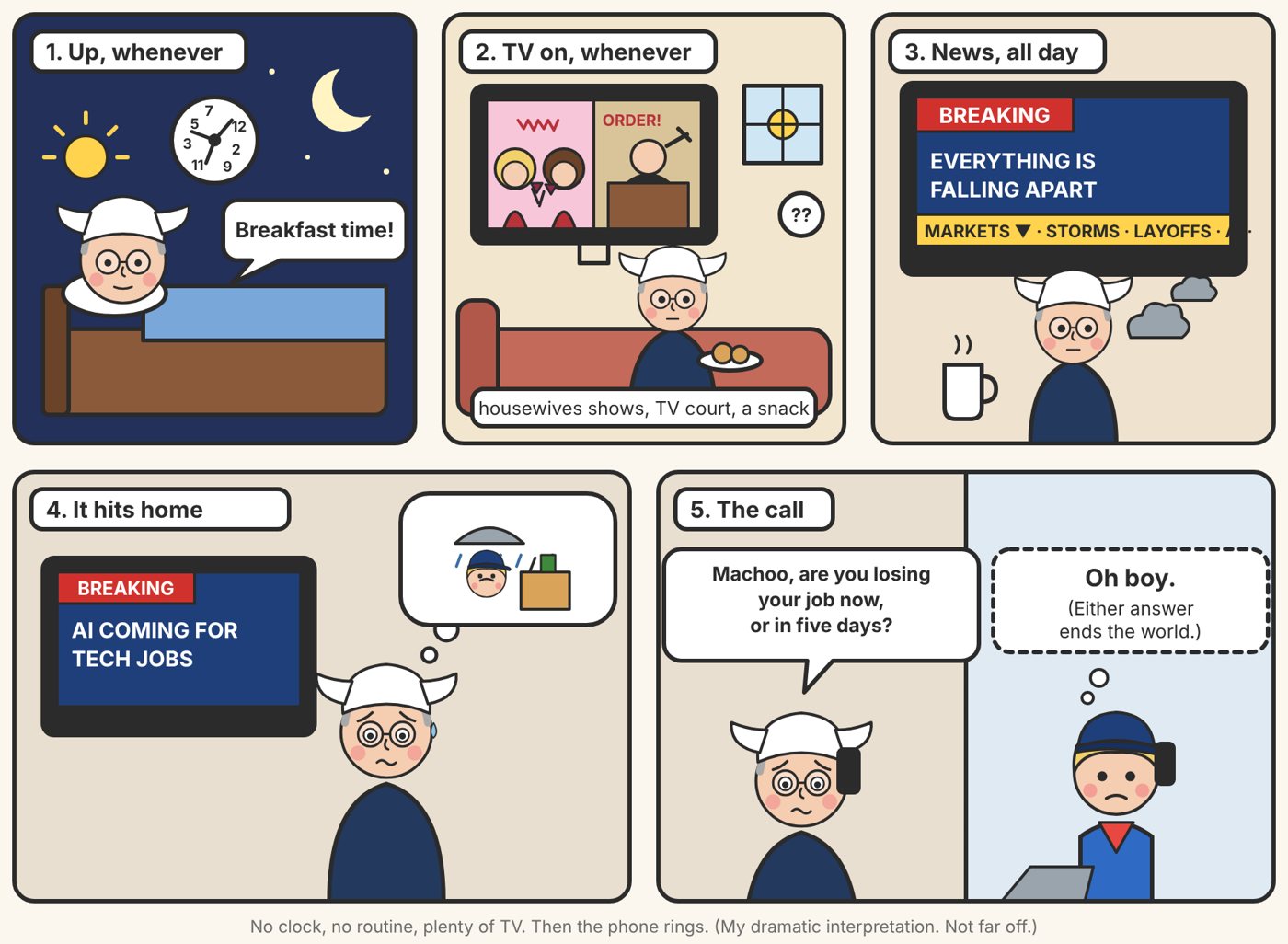
Today I wait for the call, then deflect: mostly an "oh boy" and a change of subject. It gets us off the phone. It doesn't end the worry.
There's a second loop, and it runs the other way. When I say anything in Dutch, she emails her brothers and the family about how proud she is of her Machoo. That loop starts with me, not the TV.
The problem
Mama's picture of my working life comes mostly from loud news, and from me not giving her anything to weigh it against. So she worries, and I only hear about it once it's a loaded question. The competitor isn't another website. It's the TV.
Four bets
Written in Alex Cowan's hypothesis format, so each one can be wrong.
- Show, don’t reassure We believe that short, regular Dutch notes about what I’m working on and enjoying, for Mama, will mean fewer worried calls. We'll know when the worried calls drop against my baseline.
- Dutch is the door We believe that writing in Dutch, even imperfect Dutch, for Mama, will mean she reads it and shares it. We'll know when she forwards it to her brothers, the way she already does when I say anything in Dutch.
- Give her the story first We believe that telling her about AI and my work before the news does, for Mama, will mean AI headlines land as “that’s what Machoo does”. We'll know when she brings up a headline without the fear in it.
- The process is the content We believe that doing this as real product work, in the open, for Mama, will mean something worth sharing, with her and with you. We'll know when she asks how it’s going, or this page is worth reading.
Above the line
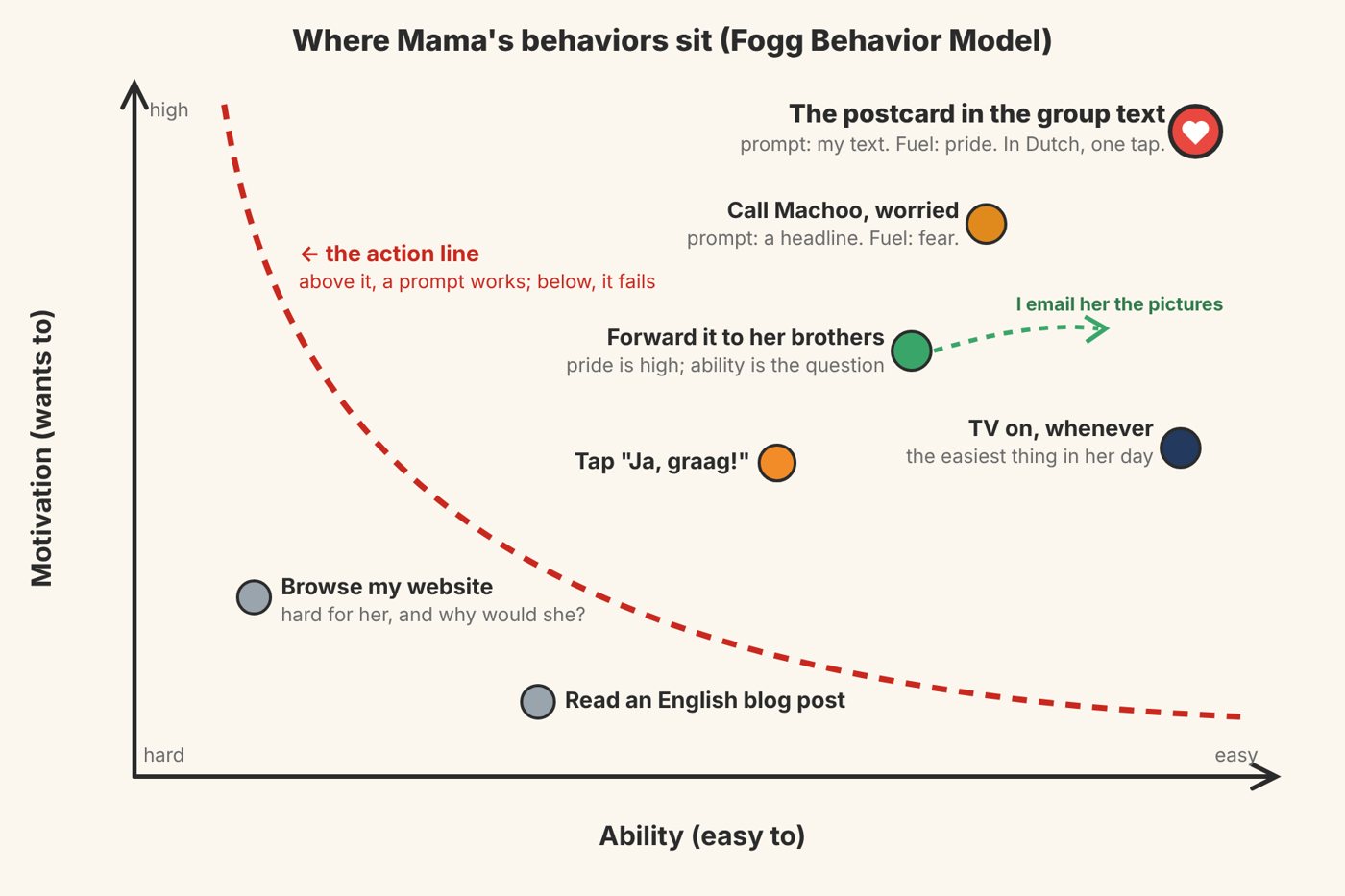
BJ Fogg's behavior model says a behavior happens when a prompt arrives while motivation and ability are high enough together: above the action line. Browsing my website sits far below it, and no amount of nagging fixes that. The worried call sits well above it, prompted by a headline and fuelled by fear.
An analogy I heard once and kept: if your product is a cure for cancer, the experience doesn't have to be great. People will crawl through the Shawshank tunnel for it. If you're selling a stick of gum, it had better be the easiest thing anyone has ever done. To Mama, browsing my website is a stick of gum.
So the door is the UX. The test has to sit way above the line: one tap, in Dutch, in a thread she already reads, prompted by me, fuelled by pride. And fun, and a bit dramatic, because she likes that.
The smallest test: a postcard
No app, no login, nothing built. A postcard, as two pictures in the family group text. A postcard because it's funny, and because it's true: we're far apart. The front is the cartoon. The back is my note, in my Dutch.
Not Dutch? Flip each card over for the English. Mama gets the Dutch.
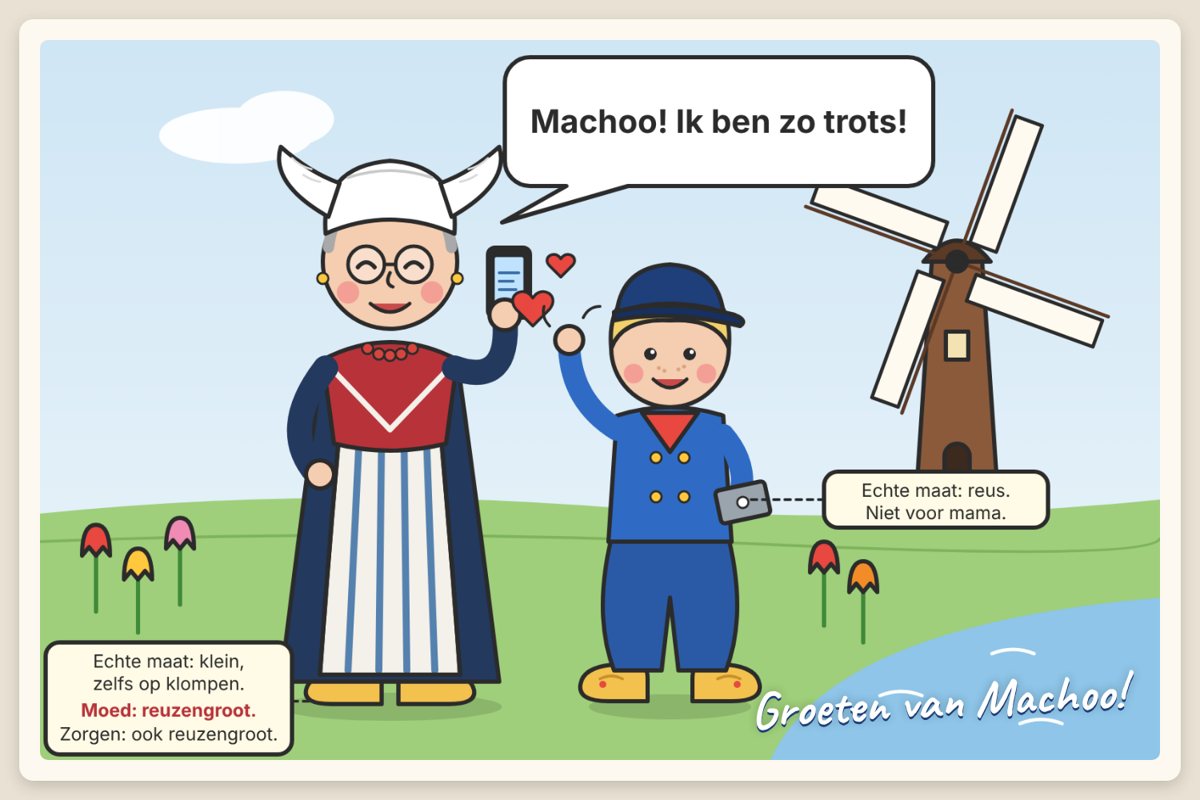
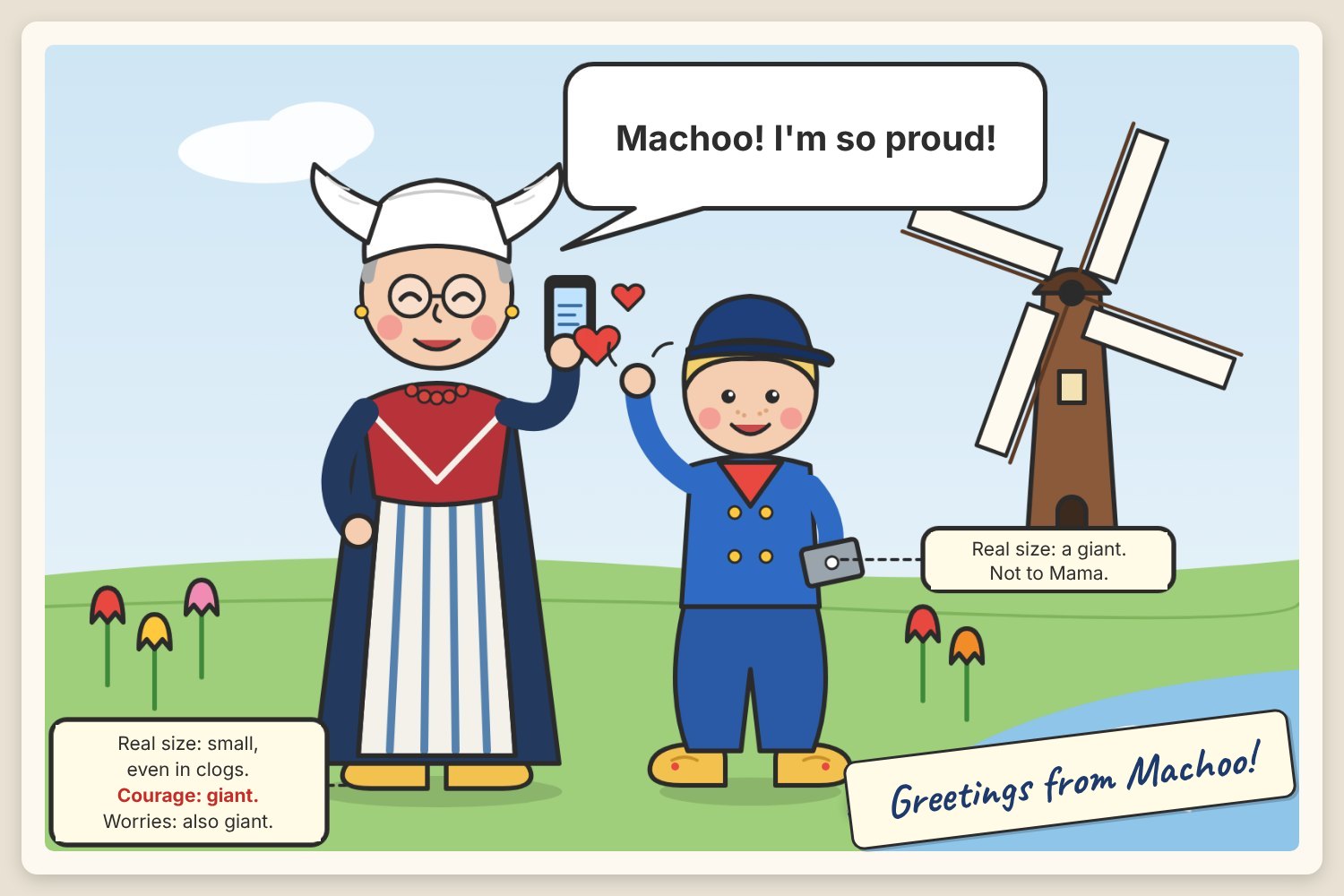
A little Dutch: Add -je to a Dutch word and it gets small and dear. Klomp is a clog. Klompje is a little clog. So is the operation.
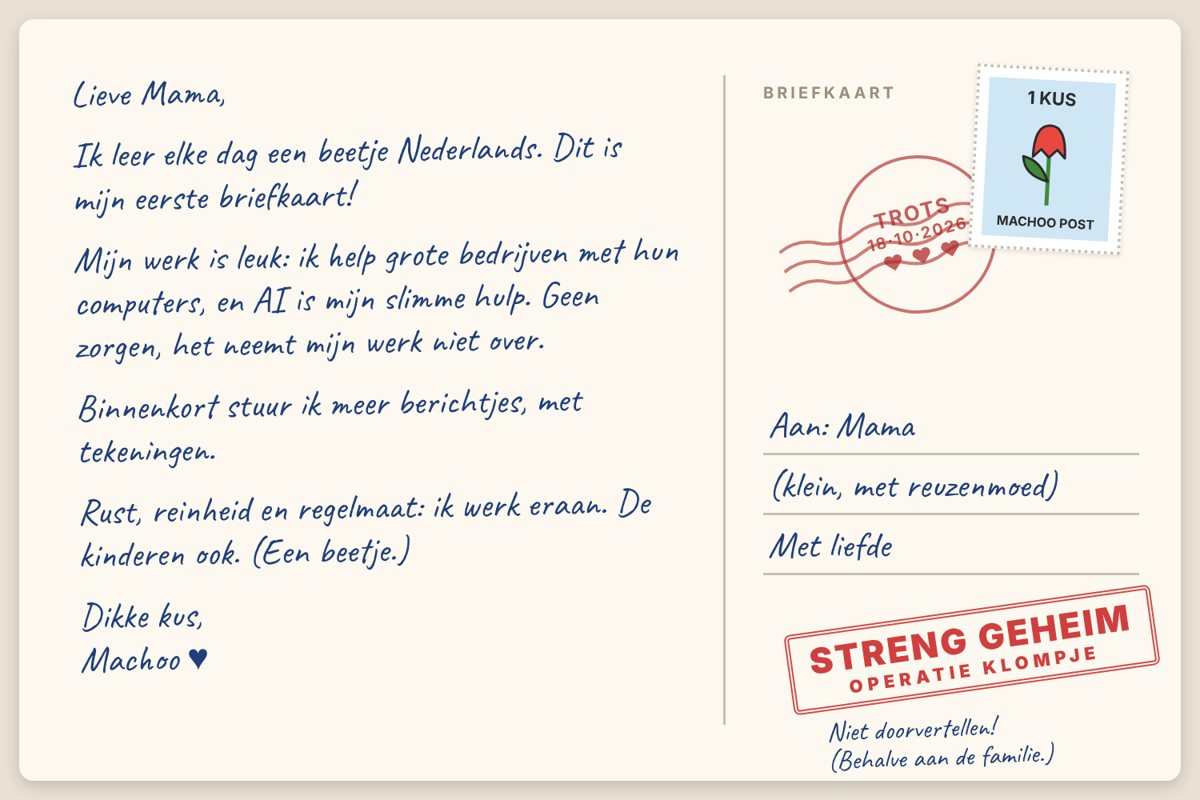
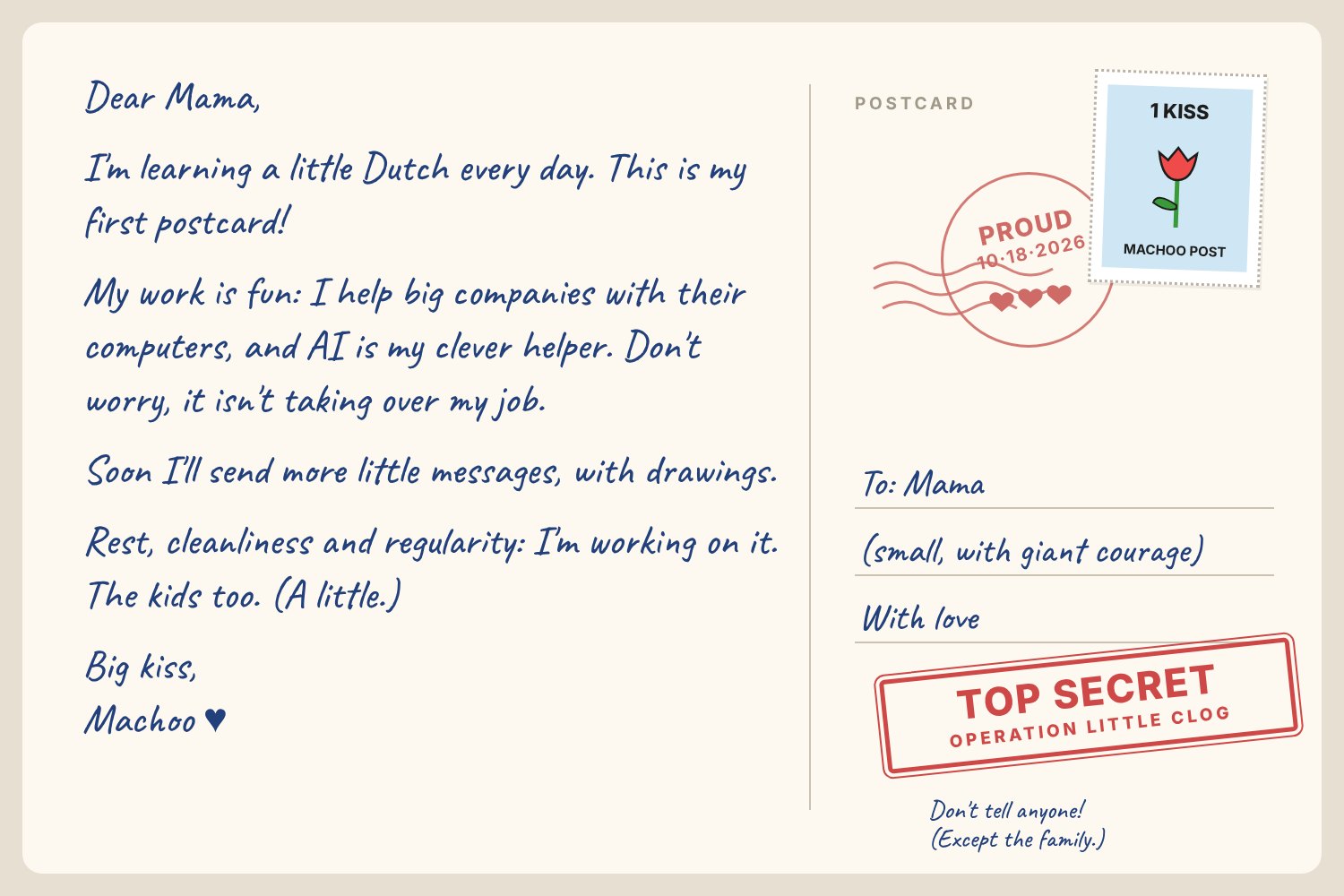
A little Dutch: "Rust, reinheid en regelmaat" is an old Dutch rule for a good home, and one of Mama's favorite sayings. A "dikke kus" is a fat kiss, which is how Dutch moms sign off.
Behind it there's a small Dutch page with one button, "Ja, graag!": yes please, more of these. It's a fake door, a Wizard of Oz test. Nothing is built behind it, and I do the rest by hand. I'm not linking it here until the test is over, so that button still means Mama said yes.
If she asks how to send the picture to the family (my guess: she will), I'll email it to her so she can just hit forward. That's the by-hand version of a "send to the family" button. The button only gets built if she asks every time.
A note on my Dutch: I'm not conversational yet, and that's the goal. Lots of Duolingo, lots of vocabulary, and a healthy fear of speaking it. This program is quietly for me too.
The customer letter: my guess at her reply
Working backwards means writing the letter you hope the customer sends you after it works, before you build anything. Here's mine, as the postcard I hope she'd send back. It's a guess, written before I sent anything, so the real reply can prove it wrong.
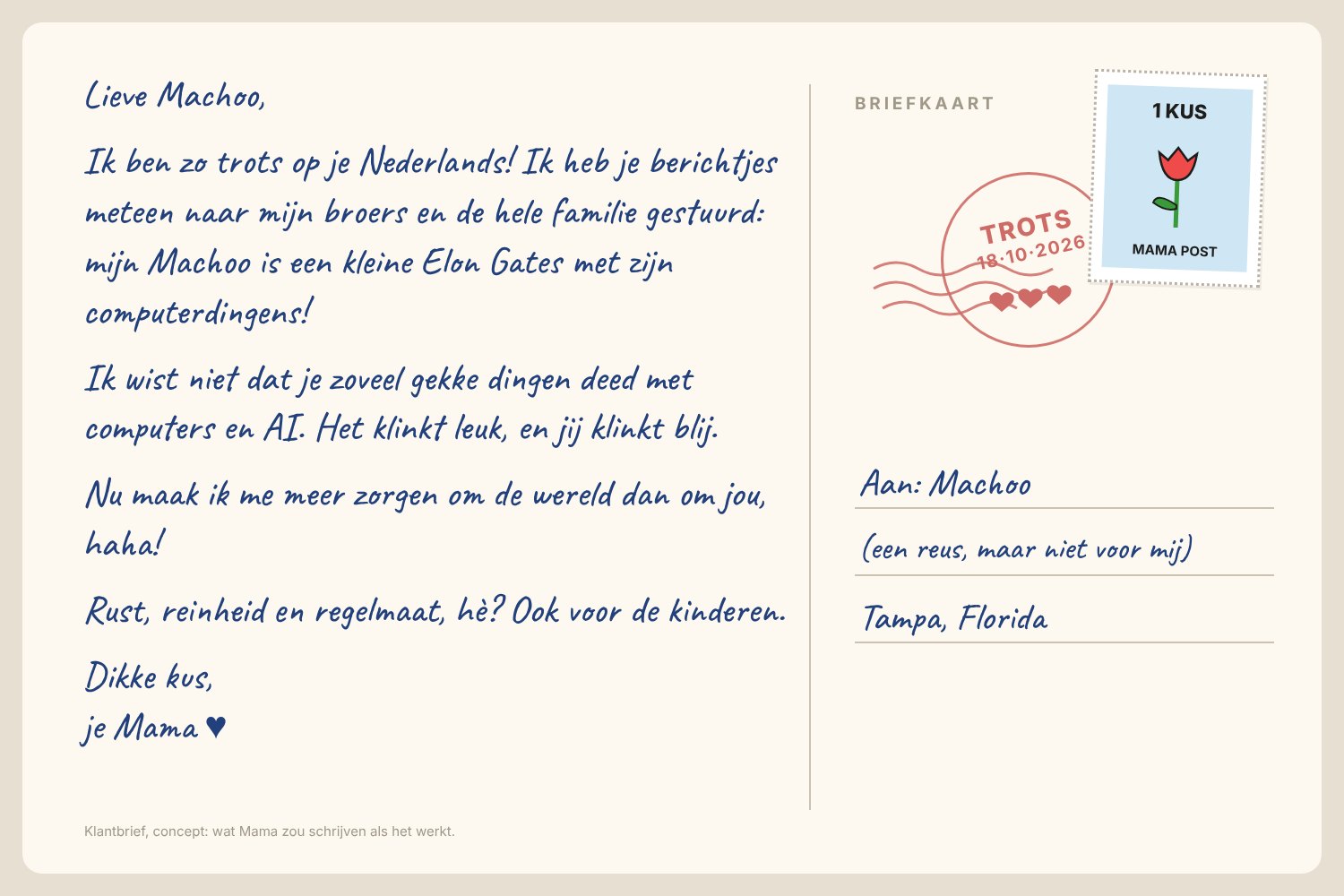
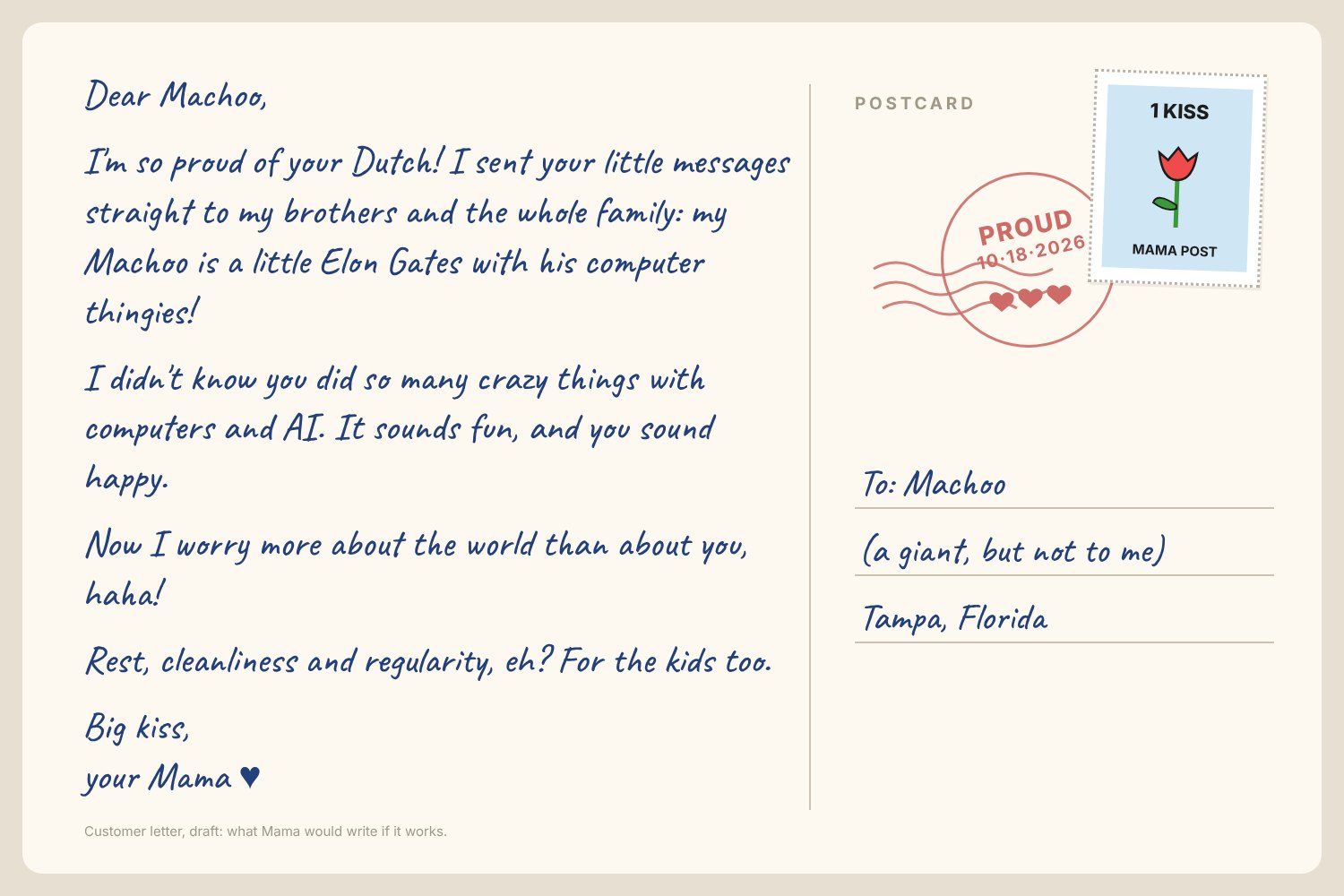
A little Dutch: "Elon Gates" isn't a typo. That's how she talks. "Computerdingens" is computer thingies, one word, because Dutch glues words together.
How we'll know
The worried calls are the outcome, but they're slow and noisy. One dramatic news week skews a month. So I watch leading signals on every note, and let the calls confirm it later.
Leading, per note
- She replies at all
- She laughs: a “haha”, an emoji, a voice note
- She replies in Dutch
- She asks a question back
- She forwards it to her brothers
- She asks how to send it on
- She taps “Ja, graag!”
Lagging, per week
- Fewer worried calls than before
- Calls that start with my news, not the TV’s
- The family mentions it
- The family starts following along
If the leading signals light up and the calls don't move, the notes are fun but not reassuring, so I'll change what they say. If the signals stay dark, I'll change the format before blaming the idea. Results here in four weeks.
Where it could end up
My read: a pipe, with a museum behind it. The texts are how she and I talk. The museum is a place where she can send the family to catch up, and where the Dutch family can follow along. That makes the family a second reader, worth getting to know before I build it. Nothing gets built until the four weeks say so.
Walking the kids through it
My kids know the customer, so they're learning the order with me: who is she, what's the moment, what does she do today, what do we believe, write the letter, find the smallest test, and count something. Build nothing until there's a number.
Standing on shoulders
- Alex Cowan: hypothesis-driven development, the day in the life, concierge and Wizard of Oz tests. His practitioner's guide.Kid version: before you build something, write down your guess and how you'll know if you were right. Then try the smallest version first, even by hand.
- BJ Fogg: the behavior model and the action line. Tiny Habits (2019).Kid version: people do something when they want to, it's easy, and something reminds them. If it's hard, make it easier instead of nagging. People will crawl through mud for a cure. A stick of gum has to be the easiest thing ever.
- Tim Herbig: connecting strategy, OKRs and discovery. Real Progress.Kid version: a big goal should connect all the way down to what you do this week, so you always know why you're doing it.
- Marty Cagan, Chris Jones and Martina Lauchengco: Inspired, Empowered, Loved and Transformed.Kid version: great teams solve a real problem for real people, check what works before they build it, and then help people love it.
- Colin Bryar and Bill Carr: Working Backwards, where the customer letter comes from.Kid version: write the thank-you note you hope to get before you start. Then make the thing that earns it.
The words, for kids
- Customer
- The person you're making it for. Here: Oma.
- Day in the life
- Draw their day, so you can find the best moment to help.
- Hypothesis
- A guess you can check.
- Customer letter
- The note you hope they'll send you when it works. Written first.
- Fake door
- A button for something that doesn't exist yet, to see if anyone presses it.
- Wizard of Oz
- It looks like a machine, but a person is doing it behind the curtain. (Dad emailing the pictures.)
- Leading signal
- An early clue it's working: Oma replies, laughs, writes back in Dutch.
- Lagging signal
- The slow proof: fewer worried phone calls.
The postcard is also on the wall in Arts and crafts. The rest of what feeds this site is on the credits page.